
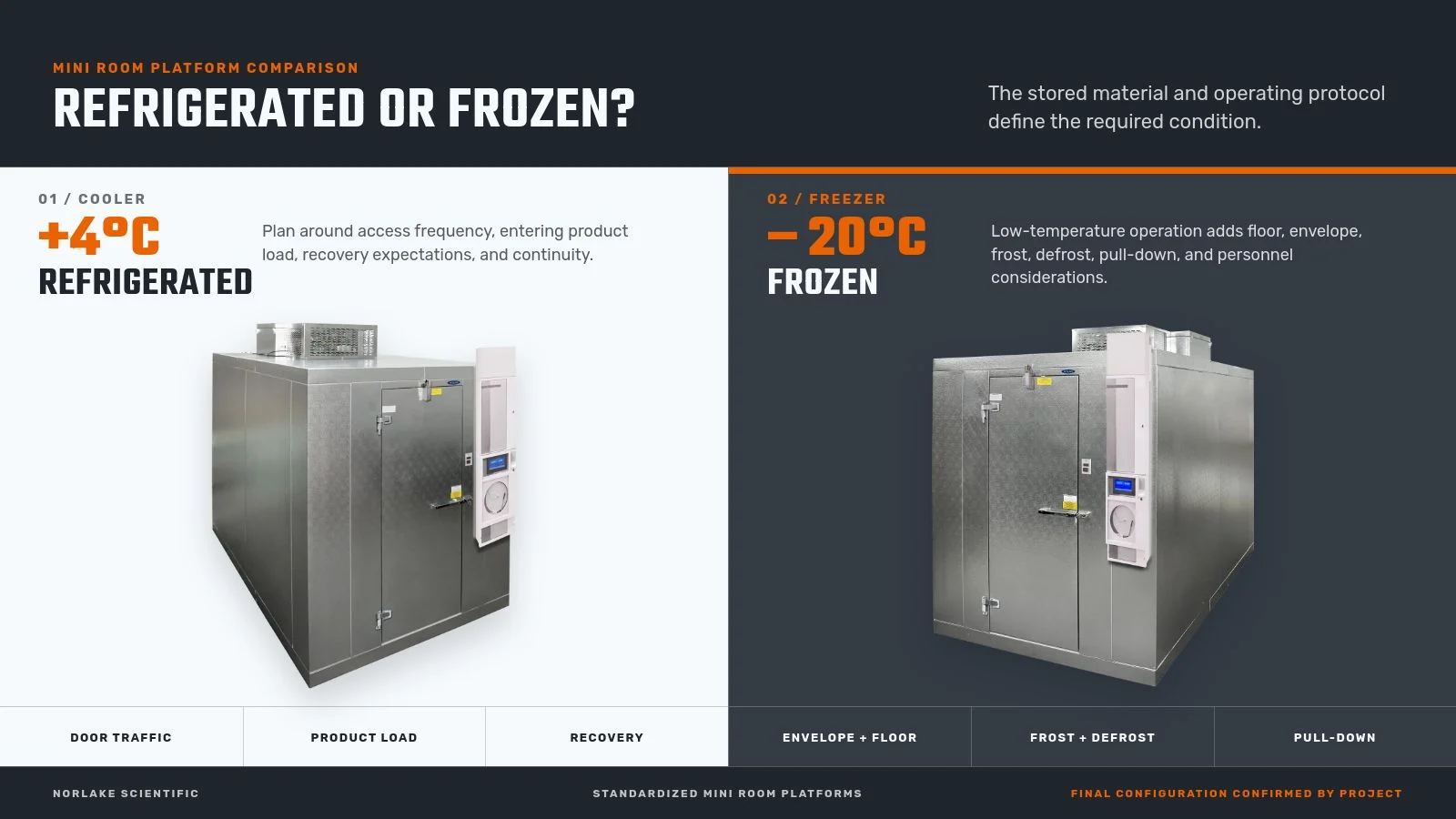
Choose the temperature regime before the room format
A laboratory cold room and freezer room may share a walk-in format, but the operating temperature changes the design questions that follow. Start with the material’s approved storage condition, then compare the envelope, frost, load, access, and continuity consequences.
This matrix is a decision aid. It does not assign a universal temperature, floor design, defrost method, recovery result, or safety procedure.
Cooler versus freezer consequence matrix
| Question | Cooler-room review | Freezer-room review | Evidence or owner |
|---|---|---|---|
| Approved condition | Record the material’s refrigerated requirement | Record the material’s frozen requirement | Material owner or approved procedure |
| Envelope | Review panels, doors, floor, and facility conditions | Review panels, floor, doors, vapor control, and low-temperature details | Engineering and facilities |
| Moisture and frost | Review infiltration and access effects | Review frost formation, defrost, and access effects | Engineering and operations |
| Entering load | Record material temperature and mass when relevant | Review product pull-down demand and load assumptions | Engineering and operations |
| Access | Record traffic, staging, retrieval, and door events | Add frost, personnel exposure, and low-temperature procedure questions | Operations owner |
| Continuity | Define response window and alternate capacity | Define separate transfer path, response, and alternate capacity | Program owner |
| Product path | Compare published cooler platform requirements | Compare published freezer platform requirements | Project owner and engineering |
Let the material define the condition
Do not choose cooler or freezer operation from convenience. Record:
- Approved label, procedure, or protocol.
- Packaging and segregation needs.
- Material sensitivity and consequence of an excursion.
- Entering material condition when relevant.
- Response and alternate-storage requirements.
If a program needs both refrigerated and frozen conditions, plan them as separate operating environments unless a reviewed configuration explicitly supports the combined workflow.
Review low-temperature consequences
Freezer operation may change the review of:
- Floor, door, panel, and vapor-control details.
- Moisture infiltration, frost, and defrost.
- Product entering temperature and load.
- Access, staging, and personnel procedures.
- Continuity, transfer, and alternate capacity.
These are engineering and operations questions, not universal specifications. Do not add a threshold, duration, recovery result, or safety requirement without an approved source.
Compare access and continuity
Frequent openings can introduce moisture and heat. Record the operating pattern for each condition:
- Door schedule and duration.
- Receiving and staging path.
- Retrieval frequency.
- Personnel exposure and procedure.
- Alarm responsibility.
- Backup space and transfer route.
- After-hours response.
Monitoring, chart recording, remote access, detachable tablets, alarm packages, and redundancy are optional or configurable by project scope. The continuity plan remains the owner’s responsibility unless a reviewed project scope states otherwise.
Choose the Norlake Scientific product path
Published cooler or freezer platform
Review Norlake Scientific Mini Rooms when the project fits the published +4°C cooler or -20°C freezer platforms, available footprint, inventory, access, and facility requirements. Final configuration and options are confirmed during engineering review.
Custom room-scale requirement
Review Norlake Scientific environmental rooms when the required geometry, operating profile, humidity, lighting, installation, or controls need custom review.
Unresolved storage decision
Return to the Laboratory Cold Room Guide when material, inventory, workflow, or facility inputs remain open. Use the request-a-quote path after those inputs are assembled.
Frequently asked questions
Can one room switch between cooler and freezer operation?
A project-specific operating profile must be reviewed. Do not assume that a room optimized for one condition can change freely without implications for capacity, floor, frost, defrost, controls, and loads.
What standardized conditions does Norlake Scientific Mini Room offer?
Norlake Scientific Mini Room is offered in published +4°C cooler and -20°C freezer platforms, with final configuration and options confirmed for the project.
Continue planning
- Laboratory Cold Room Guide. Complete the material, workflow, capacity, facility, and continuity scorecard.
- Laboratory Cold Room Design Checklist. Prepare a laboratory-specific brief for engineering or quote review.
- Norlake Scientific Mini Rooms. Compare standardized cooler and freezer room platforms.
- Norlake Scientific environmental rooms. Review custom room-scale requirements.